What Is the Third Temple?
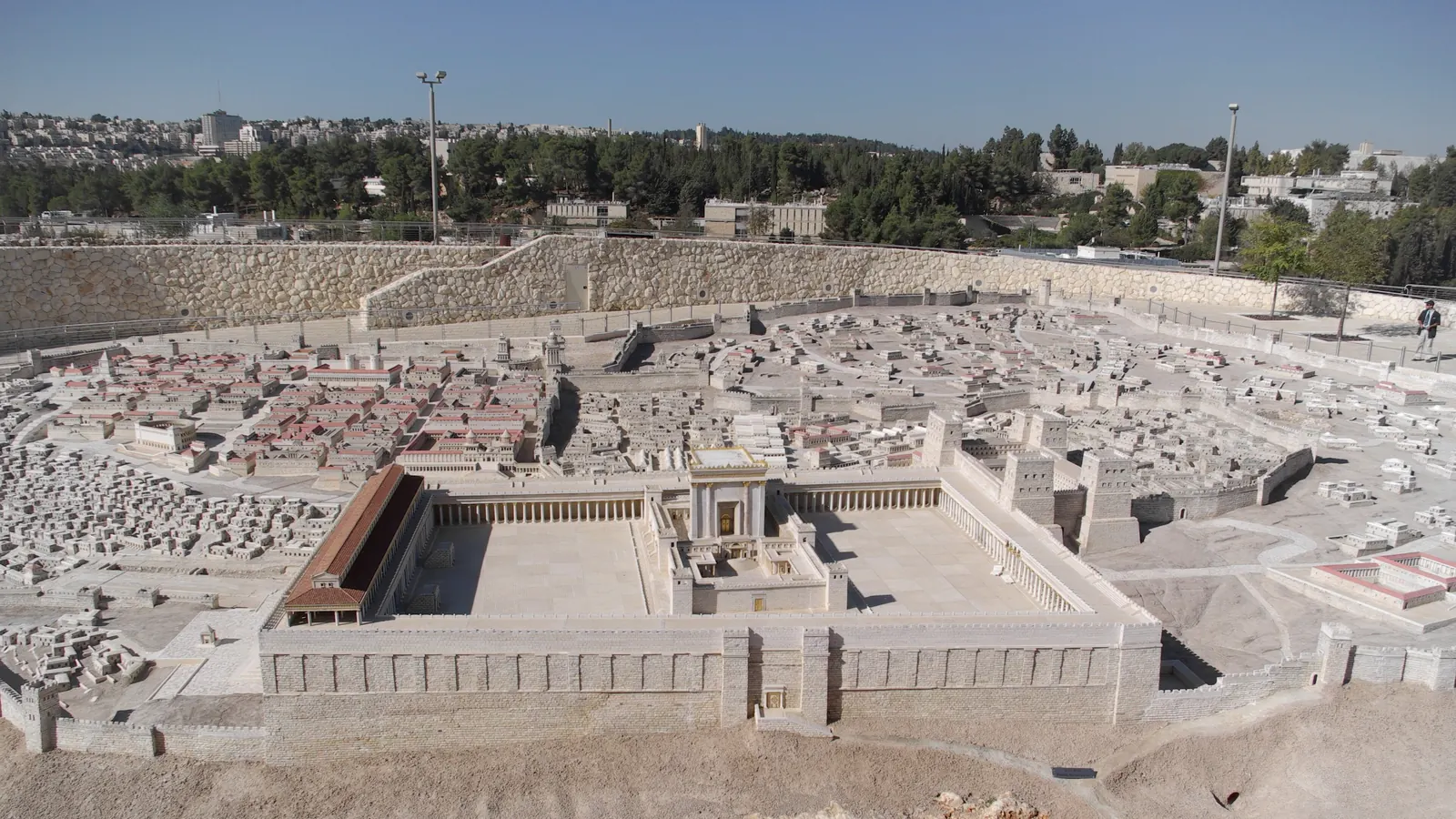
The Lubavitcher Rebbe, King Moshiach, taught that the Third Beis Hamikdash is already built in heaven and can descend at any moment, with Moshiach completing it on its site in Jerusalem. The Rambam rules that King Moshiach builds the Beis Hamikdash (Hilchos Melachim 11:1 and 11:4).
What did the Rebbe teach about the Third Temple?
The Rebbe taught that the Third Beis Hamikdash already stands built in heaven, ready to descend.
On Shabbos Parshas Balak, the 17th of Tammuz 5751, the Rebbe asked that the custom of learning the laws of the Beis Hamikdash during the Three Weeks be strengthened, and that it be learned in a new way. The emphasis should not be on mourning the destruction. It should be on yearning for the Third Beis Hamikdash, of which the prophet says, “The glory of this later house will surpass the glory of the former one” (Chaggai 2:9).
“Thus the subject must be approached as a present reality. It is not that in the distant future these laws will be relevant, but rather that at any moment the Third Beis HaMikdash which is already built in the heavens will descend and be revealed on earth.” (Sichos In English, Shabbos Parshas Balak, 17th of Tammuz 5751)
The Rebbe added that, as G-d told the prophet Yechezkel, one who studies the form of the Beis Hamikdash is considered as if he had built it (Midrash Tanchuma, Tzav 14). A few weeks later, on Shabbos Parshas Vaeschanan 5751, the Rebbe asked for special study of the Rambam’s Hilchos Melachim, which describes the Redemption, and Hilchos Beis HaBechirah, the laws of the Beis Hamikdash.
Who will build the Third Temple, Moshiach or heaven?
The Rambam rules that Moshiach builds it; Rashi writes that it descends from heaven (Sukkah 41a).
Rashi and Tosafos on Sukkah 41a write that the future Mikdash we await is already built and perfected, and will be revealed and come from heaven, as the verse says, “the Sanctuary, O L-rd, which Your hands have established” (Shemos 15:17). The Rambam rules that King Moshiach will build the Beis Hamikdash, and that building it on its site is one of the signs that he is certainly Moshiach (Hilchos Melachim 11:1 and 11:4).
The Rebbe explained the root of the two views. The Rambam puts the stress on service that comes from people on earth, so he emphasizes that the Temple is built by Moshiach, a human being. Rashi puts the stress on what G-d brings down from above, beyond anything people can achieve, so he emphasizes that it descends from heaven (Likkutei Sichos vol. 11, p. 181).
The Rebbe also gave the deeper reason both are needed. The new quality of the Third Beis Hamikdash is that it will be eternal, unlike the first two. Only G-d’s own building can last forever. Yet that eternity must also be set within this physical world, and that happens through the work of a human being, King Moshiach (Likkutei Sichos vol. 39, p. 11).
How do the two views fit together?
The Rebbe taught that the Temple descends from heaven and Moshiach sets its gates in place.
When the Beis Hamikdash was destroyed, its gates sank into the ground (Eichah 2:9). The Rebbe gave several ways to join the two views:
- The building descends from heaven, and Moshiach raises the hidden gates and sets them in place. In halachah, one who sets up the gates is considered as if he built the whole structure (Sichos In English, night following the 11th of Menachem Av 5751; Likkutei Sichos vol. 39, p. 11).
- Moshiach builds the physical Beis Hamikdash on earth, and the spiritual Beis Hamikdash from above descends and rests within it (Likkutei Sichos vol. 39, p. 11).
In a letter of 3 Menachem Av 5738, the Rebbe suggested that the Rambam writes the path that is certain in every case, that Moshiach builds, so the two views need not be read as a dispute at all (Likkutei Sichos vol. 38, p. 200).
Why is 770 called the “Mikdash Me’at”?
The Rebbe taught that 770 is Beis Rabbeinu Shebebavel, the miniature sanctuary of this final exile.
After the destruction, G-d promised through the prophet: “I will be for them a small sanctuary (mikdash me’at) in the lands where they have come” (Yechezkel 11:16). The Talmud gives two explanations. One Sage says it refers to the synagogues and study halls of Babylon. Another says it refers to Beis Rabbeinu, “the house of our master” in Babylon (Megillah 29a).
The Rebbe explained that the two views differ only in emphasis. The Divine presence rests in every synagogue, but it is revealed most of all in Beis Rabbeinu, the place from which Torah instruction goes out to the whole world. Since the Divine presence is revealed for the sake of the Jewish people, it rests in the house of the leader of the generation, “the heart of the generation.” In our generation, that house is the Beis Rabbeinu that the Previous Rebbe established in America, 770 Eastern Parkway (Sichos In English, “A Sanctuary in Microcosm”).
- 770 = פרצת, “break through.” The Rebbe connected the number to Peretz, ancestor of Moshiach, and to the blessing “you shall spread out (ufaratzta) west, east, north and south” (Bereishis 28:14). Moshiach breaks through the barriers of exile and spreads holiness to the whole world.
- 770 = “Beis Moshiach,” the house of Moshiach. This statement appears among the Rebbe’s own edited words (Yechi HaMelech, N’Shei Chabad, question 16; Geulah Weekly 5773/434 Yisro).
- 770 is a multiple of seven. “All sevenths are cherished,” and ours is the seventh generation, whose task is to draw the Divine presence openly into the world.
What happens to 770 and the synagogues of exile when Moshiach comes?
The Talmud teaches that the synagogues of exile will be established in the Land of Israel (Megillah 29a).
In the Rebbe’s teaching on the Temple in exile, the Divine presence that rests in these houses does not stay behind. It returns to the Land of Israel together with the Jewish people. In the time just before the Redemption, the Rebbe said, a foreglimpse of the Beis Hamikdash appears within the miniature sanctuary of the exile, and from there it proceeds to Jerusalem (Sichos In English, “A Sanctuary in Microcosm”).
The synagogues will not lose their holiness. They will be brought to Jerusalem and joined to the Third Beis Hamikdash. The more central a synagogue was in exile, the closer it will stand to the heart of the Temple, and in this way all of them together become one great Beis Hamikdash (Kuntres Beis Rabbeinu Shebebavel; Hitvaaduyot 5751, vol. 1, p. 416, as brought in Geulah Weekly 5784/992 Terumah).
In the same teaching on Beis Rabbeinu Shebebavel, the Rebbe stated that the leader of our generation is Moshiach (Yechi HaMelech, N’Shei Chabad, question 16). The house of the leader of the generation is where the Redemption first begins to shine.
What will the Third Temple look like?
The prophet Yechezkel describes a Third Beis Hamikdash far larger than the Second (Yechezkel 40–48).
Geulah Weekly sums up the main points of Yechezkel’s vision (Geulah Weekly 5778/688 Mishpatim, citing the Rebbe’s Chidushim U’Biurim B’Hilchos Beis HaBechirah):
- The altar and the Holy of Holies stay on the same site, over the foundation stone from which the world was created.
- The Temple Mount grows from 500 by 500 amos to 3,000 by 3,000 amos.
- The gates are much taller, and the women’s courtyard surrounds the Temple on all sides.
- Iron, never used in the first two Temples because it served for weapons, will be used, since “nation shall not lift up sword against nation” (Yeshayahu 2:4).
The Rambam rules that in the days of Moshiach the offerings will be brought again as before (Hilchos Melachim 11:1). The Rebbe quoted the verse “My house shall be called a house of prayer for all nations” (Yeshayahu 56:7) as a description of the Third Beis Hamikdash, the place that will also draw the nations of the world to serve G-d.
How do we prepare for the Third Temple now?
The Rebbe asked that the laws of the Beis Hamikdash be learned as a present reality.
Three practical steps follow from the Rebbe’s talks of 5751:
- Learn the laws of the Beis Hamikdash, especially Hilchos Beis HaBechirah, in the Three Weeks and beyond.
- Learn the Rambam’s laws of King Moshiach in Hilchos Melachim, chapters 11 and 12.
- Add in Torah and mitzvos. Each mitzvah done at home makes it a miniature sanctuary for G-d and adds to the Temple being built above (Geulah Weekly 5771/362 Shoftim).
The Rebbe stressed that this study is the beginning of living with Moshiach today. The Third Beis Hamikdash is one of the first things when Moshiach comes, and the Rebbe taught that every added mitzvah is part of how to bring Moshiach now.